

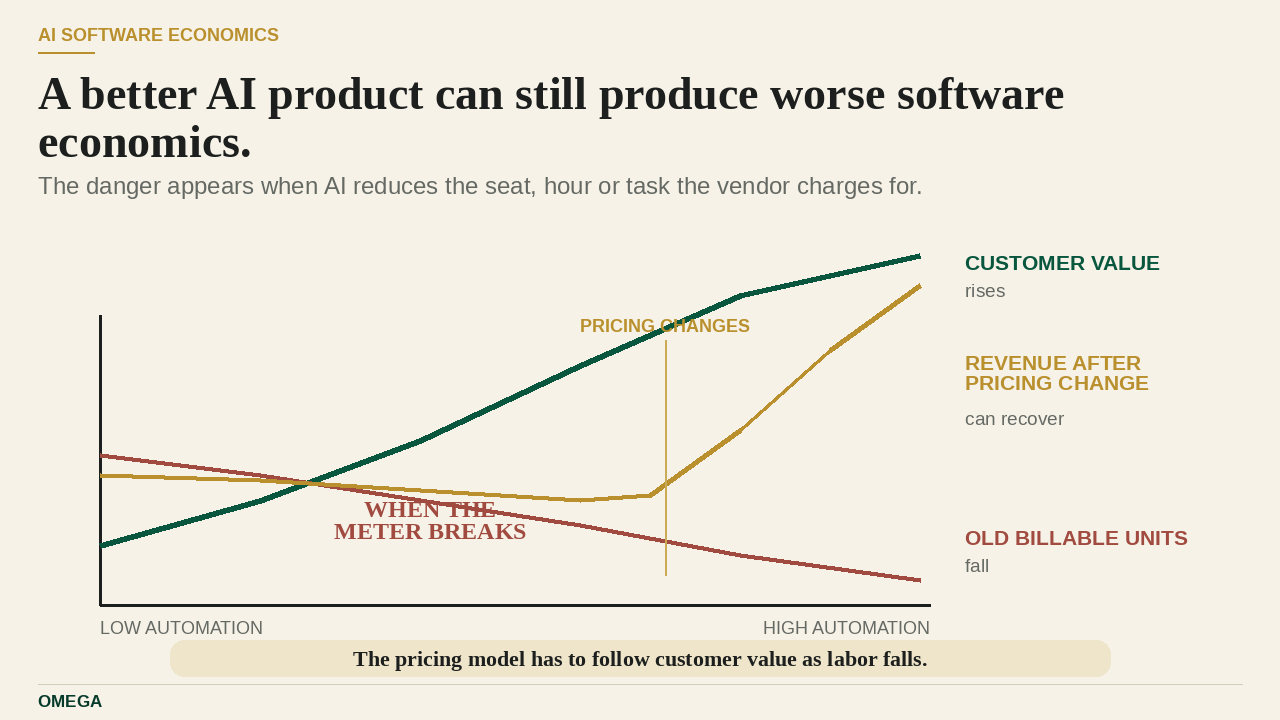
Business model risk starts with the meter. When AI automates the seat, hour, ticket, or task a vendor bills for, product success can weaken the unit that generates revenue.
Imagine a software product that doubles a customer team’s productivity and cuts the number of seats the customer needs by a third. The user experienced a better product. The vendor inherited a pricing problem.
This is one of the least appreciated tensions in enterprise AI. For years, software companies often charged against proxies for work: seats, agents, transactions, hours, messages, cases, or modules. AI can increase the value delivered while shrinking some of those proxies.
Call this billing-unit risk: the possibility that AI automates, compresses, or bypasses the very unit a company counts to get paid. It belongs in underwriting before the revenue multiple does.
Business model risk begins with the meter
The first diligence question is simple: what exactly causes the invoice to grow?
Per-seat pricing works beautifully when more customer value requires more users. It becomes less aligned when one person with AI can do the work of several. Per-hour pricing works when delivery effort is a defensible proxy for value. It strains when AI reduces the hours. Per-interaction pricing can expand with engagement, or collapse if an agent resolves the job in one exchange.
The core issue is alignment. A strong meter increases as the customer receives more economic value. A fragile meter shrinks as the product succeeds.
That makes pricing architecture a product question, not a finance footnote. The more AI changes the production function, the more important it becomes to know whether the revenue model moves with the outcome or against it.
AI can automate the thing a vendor counts to get paid
Consider customer support. A legacy help-desk model can charge for human-agent seats. An AI agent that resolves a larger share of conversations can reduce the number of human seats required. The vendor may create more value for the customer while pressure builds on the old seat count.
The market is already experimenting with new meters. Intercom prices its Fin AI Agent from $0.99 per outcome and offers a standalone version with no seats required. Its help documentation defines billable outcomes around successful resolutions and completed procedures. Salesforce offers Agentforce through several models, including Flex Credits that meter agent actions, conversations, and per-user licensing.
These examples do not establish a universal destination for AI pricing. They establish something more useful: serious vendors are separating the value created by agents from the old assumption that software revenue must scale with human seats.
Incumbents and entrants start from different constraints
An incumbent SaaS company can face a genuine internal conflict. Its AI product may save the customer labor while the legacy model monetizes the number of people using the software. Management can protect the old meter, add usage on top, repackage the product, or migrate toward an outcome that customers will accept as measurable and fair.
An AI-native entrant has a cleaner sheet of paper and a harder proof problem. It can price around outcomes from the beginning, yet it must define an outcome precisely, measure it credibly, protect gross margin, and avoid taking economic risk it cannot control.
Neither starting position guarantees the better business. The incumbent may own distribution, data, workflow, trust, and budget. The entrant may align price to value more cleanly. The underwriting question is which company can redesign the meter without losing either the customer or the economics.
The best billing unit is close to value and hard to game
Outcome pricing sounds elegant until the outcome depends on variables outside the product. A sales system cannot control macro demand. A legal tool cannot guarantee a court result. A cybersecurity product can reduce risk without proving the breach that never happened.
The practical answer is often a meter one step upstream from the ultimate business result: a resolved support issue, a completed workflow, a qualified case, a processed document, an approved action. The customer can observe it, the vendor materially influences it, and both sides can agree on the count.
That creates four diligence tests. Does the unit rise with customer value? Can both parties measure it? Does AI make the unit larger or smaller? Can the vendor deliver the unit at attractive incremental economics?
A pricing model that passes those tests can improve as automation improves. A model that fails them can turn technical success into revenue compression.
There is a second economic test behind the meter: cost to serve. Outcome pricing can align revenue with customer value and still produce poor economics if the vendor absorbs expensive inference, exception handling, or human review. Usage pricing can protect gross margin and still feel misaligned if customers cannot connect usage to value. The best model therefore balances three curves at once: customer value, billable volume, and marginal delivery cost. AI changes all three, sometimes at different speeds.
Underwrite the billing unit before the multiple
Omega’s current enterprise AI build-versus-buy work asks what customers cannot economically recreate as code gets cheaper. Billing-unit risk asks the adjacent question: after the customer decides to buy, what exactly will keep the invoice growing as labor gets cheaper?
The diligence sequence should start with the customer outcome, then work backward. How much labor can AI remove or amplify? Which old billing units shrink as that happens? What new meter can the vendor defend? Who owns the productivity gain? How much of the workflow does the vendor control? What happens to gross margin as usage expands?
Those questions separate product adoption from revenue durability. An AI feature can be loved and still weaken monetization. A smaller vendor can have a superior meter and still lack distribution. A seat-based incumbent can remain formidable if it migrates pricing without sacrificing customer ownership.
The durable business model keeps a fair claim on customer value after the labor proxy disappears.
Related Omega Insights
- Enterprise AI Build vs Buy: When Customers Build Instead — Omega’s Rebuild Test, cited by Business Insider
- The AI Adoption Paradox — Faster Progress Raises the Value of Flexibility
- Accountability is Vertical AI’s Durable Moat