
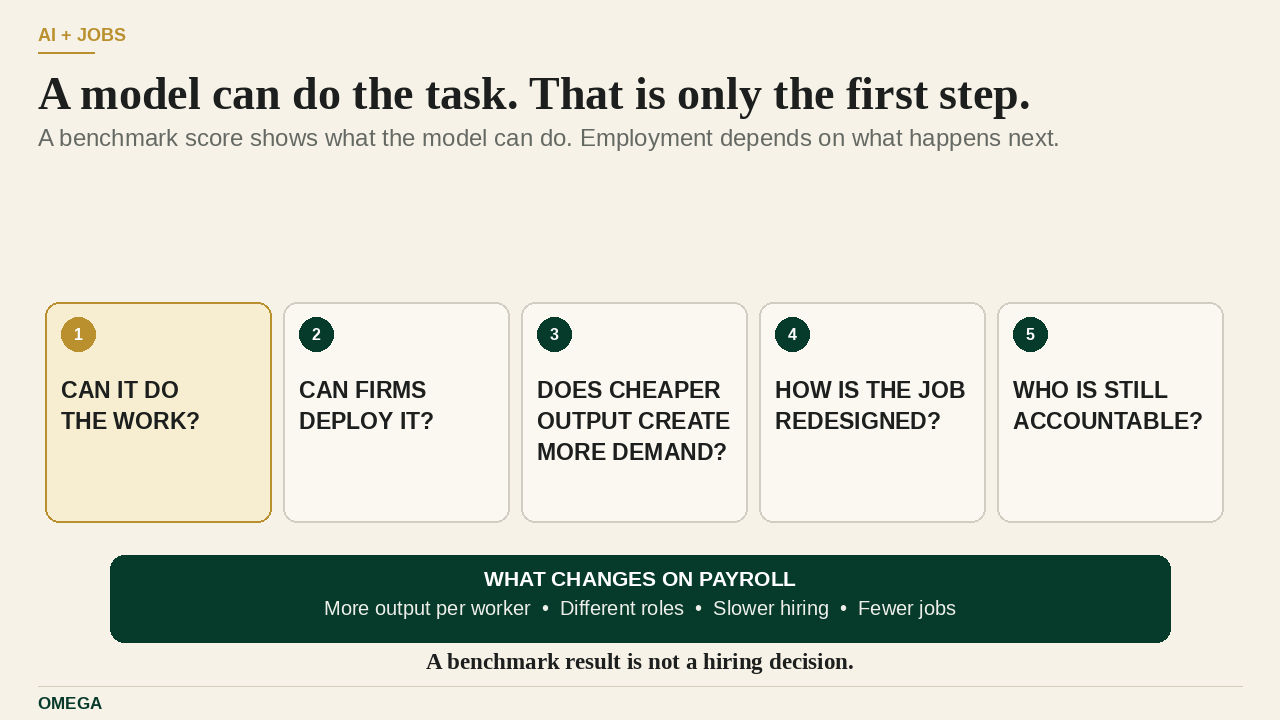
AI and jobs are separated by five economic gates: capability, adoption, demand, workflow design, and accountability. A benchmark can open the first gate without moving payroll.
Can a model write your report? That is a technical question. Does your employer need fewer analysts once it can? That is an economic one.
The debate over AI and jobs often collapses those questions. One side sees benchmark scores and extrapolates to occupations. The other sees stable aggregate employment and concludes the disruption is overstated. Current evidence supports neither shortcut. AI can change tasks before it changes titles, reduce hiring before it triggers layoffs, and improve company economics without erasing an occupation.
A job is a bundle of tasks inside a market. Between a model performing a task and a company changing payroll sit five gates. Investors should follow them in order.
AI and jobs begin with capability, not with a forecast
The International Labour Organization estimates that one in four workers globally are in occupations with some degree of generative-AI exposure. Its more important conclusion is that most exposed jobs still require human input, making transformation more common than outright redundancy in its assessment.
That distinction is easy to lose. Exposure says a task may be affected. It says little by itself about timing, deployment cost, demand response, organizational behavior, or whether a person remains responsible for the output.
A revised August 2026 Stanford Digital Economy Lab study shows why both levels matter. It finds no widespread economy-wide displacement, while workers ages 22–25 in highly AI-exposed occupations had an employment path about 19% below less-exposed peers. The difference appeared mainly through hiring. Aggregate calm can coexist with sharp pressure at the edge.
The second gate is adoption inside the real workflow
A benchmark measures what a system can do under specified conditions. A labor market measures what employers and workers actually do with it.
An August 2026 NBER working paper using a nationally representative U.S. survey describes workplace adoption as widespread and shallow. Generative AI appears across many occupations and tasks, yet fewer than half of workers adopt it within most of them. Exposure explains some of the variation in use, far from all of it.
The gap contains the unglamorous work of enterprise adoption: data access, security, procurement, integration, training, incentives, and workflow redesign. A task can be technically automatable for years before an organization changes how the work is staffed.
This is why company-level diligence beats occupational labels. Two firms can employ similar workers and reach different staffing outcomes because one redesigns the process while the other places AI beside the old process.
The Stanford evidence adds a useful distinction inside that gap. The employment declines were concentrated in occupations where observed AI use tends to automate human tasks; occupations where AI is used more as a complement were flatter or stronger for experienced workers. The authors do not present that pattern as a universal causal law. For investors, it is still a useful reminder that “AI adoption” is too coarse a variable. The design of the adoption matters.
The third gate is demand: cheaper output can expand the market
Productivity does not mechanically translate into fewer workers. Price and demand sit between them.
If AI lowers the cost of software, legal analysis, design, or support, the employment effect depends partly on what customers do with the lower price or higher quality. Deep unmet demand can absorb more output. Saturated demand can turn the same productivity gain into fewer people. A cheaper service can also create customers who previously bought nothing.
This matters for venture investors because a startup does not need an entire occupation to disappear to create substantial value. It needs a buyer with a reason to change a workflow. The commercial opportunity can expand even while the occupation remains resilient.
The reverse is also true. A spectacular benchmark can have weak commercial value if the surrounding process, budget, or customer behavior stays put.
Workflow design and accountability decide how substitution lands
Even after capability and adoption arrive, the organization chooses how work is divided. AI may replace a task, increase one worker’s span, create an exception-handling role, or move human effort toward review and integration.
A March 2026 revision of an NBER study of Danish workers estimates precise null effects on earnings and recorded hours two years after ChatGPT, while documenting task reorganization, including AI oversight and integration work. The surface remained stable while the structure underneath changed.
Accountability can also preserve a human role after capability arrives. Legal, regulatory, fiduciary, or social obligations may still require a person to sign, explain, supervise, or defend the decision. That does not freeze the old job. One senior person may oversee far more output, junior tasks may contract, and new review work may appear.
Omega’s current work on accountability and enterprise autonomy addresses the control architecture directly. For labor analysis, the same point is simpler: technical permission to act and institutional permission to rely on the action are different gates.
Follow the chain from benchmark to payroll
The diligence sequence is now clearer. First: can AI perform enough of the task at the required quality and cost? Second: can the employer deploy it inside the actual workflow? Third: does cheaper or better output expand demand? Fourth: how does the organization rebundle the remaining work? Fifth: who still owns the consequence?
Only then comes the employment question.
This sequence also explains why company productivity and worker outcomes can move on different clocks. A firm can shorten cycle time, increase output per employee, or hold headcount flat while demand grows. The labor response may appear later as slower hiring, different skill requirements, or a redesigned team.
Omega’s earlier Future of Work analysis argued for human-AI collaboration. The 2026 evidence adds a sharper investor lens: task exposure marks the search area; the five gates determine whether capability becomes economic substitution.
Exposure tells investors where to look. Payroll moves only after the economics catches up.